
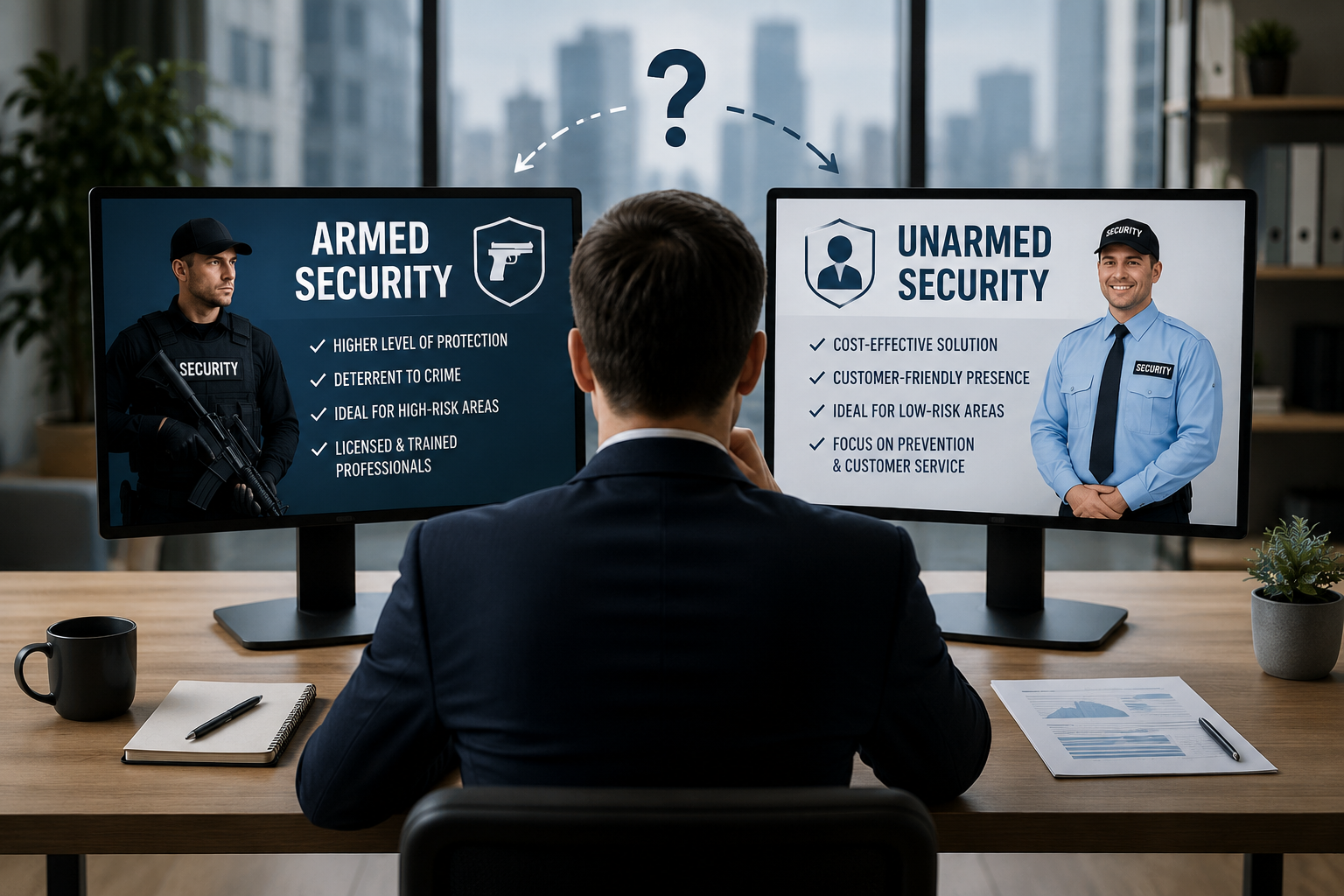
Security decisions are rarely as simple as they sound. Most businesses don’t just need “security”, they need the right kind of security for the kind of risks they actually face every day.
That’s where the armed vs. unarmed question comes in.
Some environments call for a stronger, high-alert presence where risks are serious and a fast response matters. Others work better with a professional but approachable security presence that focuses on prevention, monitoring, and keeping things under control without creating tension.
The tricky part is that both options are effective, but in very different situations.
So instead of asking which one is “better,” the real question is: which one actually fits your business environment, your risk level, and the kind of experience you want to create for employees and visitors?
That’s exactly what we’re going to unpack here in a simple, practical way.
What Is Unarmed Security?
Unarmed security guards are trained professionals who protect people, property, and operations without carrying firearms. Their strength comes from visibility, communication, awareness, and prevention.
They are not “just standing around.” In fact, in most everyday business environments, they handle a wide range of responsibilities such as:
- Controlling access to buildings, offices, or restricted areas
- Monitoring CCTV systems and reporting suspicious activity
- Patrolling premises like retail stores, warehouses, or construction sites
- Managing visitor entry and basic front-desk security tasks
- Observing and de-escalating conflicts before they escalate
- Assisting customers, employees, and visitors when needed
Think of unarmed security as the first layer of defense, focused on prevention rather than confrontation.
Where Unarmed Security Works Best
Unarmed security is commonly used in:
- Corporate offices
- Retail stores and malls
- Schools and universities
- Residential communities
- Hotels and hospitality environments
- Low to moderate-risk warehouses and facilities
If your goal is to maintain order, reduce theft, and create a safe but welcoming environment, unarmed security often fits perfectly.
What Is Armed Security?
Armed security guards are licensed professionals trained to carry firearms and respond to high-risk or potentially dangerous situations. They go through more advanced training than unarmed guards, including weapons handling, defensive tactics, and threat response.
Their presence is more assertive, and for good reason.
Armed security is typically responsible for:
- Protecting high-value goods or sensitive assets
- Securing cash-heavy operations or financial environments
- Monitoring high-risk locations with elevated threat levels
- Providing protection at large or high-profile events
- Responding to serious security threats or violent incidents
- Safeguarding executives or high-profile individuals
In simple terms, armed security is designed for situations where the stakes are higher and the risks are more serious.
Where Armed Security Makes Sense
You will usually see armed security in:
- Banks and financial institutions
- Jewelry or luxury goods stores
- Government or critical infrastructure sites
- High-crime or high-risk areas
- Large public events with elevated security concerns
- Facilities handling large amounts of cash or valuable inventory
Armed security is not about creating fear; it’s about creating a strong deterrent and a higher level of response readiness when it matters most.
The Real Differences (Beyond the Obvious)
It’s easy to think the only difference is whether a firearm is involved, but the real differences go deeper.
1. Level of Risk They Handle
- Unarmed: Low to moderate risk situations, prevention-focused
- Armed: High-risk environments with potential for serious threats
2. Approach to Conflict
- Unarmed: De-escalation, communication, observation
- Armed: Deterrence and immediate response capability if threats escalate
3. Customer Experience
- Unarmed: Friendly, approachable, service-oriented presence
- Armed: More authoritative and security-focused presence
4. Cost
- Unarmed: More budget-friendly
- Armed: Higher cost due to training, licensing, and liability coverage
5. Psychological Impact
- Unarmed: Comfortable and non-intimidating
- Armed: Strong sense of security, but can feel intense in softer environments
Advantages and Limitations of Each
Unarmed Security, Strengths
Unarmed guards are ideal when you need:
- A visible security presence without intimidation
- Customer-facing interaction
- Cost-effective protection
- Daily monitoring and routine safety enforcement
- Strong de-escalation skills
Unarmed Security, Limitations
They may not be suitable when:
- Threats involve armed or violent situations
- Assets are extremely high-value
- The risk level is elevated or unpredictable
Armed Security, Strengths
Armed guards are most effective when:
- High-level deterrence is necessary
- Immediate response to serious threats may be required
- Valuable assets or people need protection
- The environment carries elevated security risks
Armed Security, Limitations
However, they also come with:
- Higher operational costs
- More regulatory and licensing requirements
- A more intense presence that may not suit all environments
How to Decide What Your Business Actually Needs
Instead of guessing, the best way to choose is to evaluate your business through a few practical questions:
1. What are you protecting?
Are you securing people, routine operations, or high-value assets like cash, jewelry, or sensitive data?
2. What is your risk level?
Have you experienced theft, threats, or security incidents before? Or is your environment relatively stable?
3. What kind of environment do you want?
Should your security feel approachable and integrated, or strong and highly visible?
4. How does your business operate?
Retail, corporate offices, and residential spaces usually differ completely from high-risk or high-value operations.
5. Can a layered approach work?
Many businesses don’t choose one or the other; they combine both.
The Smart Option: A Hybrid Security Approach
In real-world security planning, many businesses use both armed and unarmed security together.
For example:
- Unarmed guards handle entrances, patrols, and customer-facing roles
- Armed guards are placed at high-risk points or during high-risk hours
This creates a balanced system where:
- Everyday operations stay smooth and welcoming
- High-risk areas still have strong protection
It’s not about choosing one side; it’s about placing the right level of security in the right place.
Final Thoughts
Armed and unarmed security both play important roles, but they are built for very different situations.
If your priority is prevention, visibility, and customer-friendly protection, unarmed security often makes perfect sense.
If your priority is high-risk protection, deterrence, and rapid threat response, armed security becomes more appropriate.
And for many businesses, the most effective solution is a combination of both.
The real goal isn’t just to “hire security.” It’s to build a setup that actually matches your risk level, your environment, and your business reality.
Because good security doesn’t just respond to problems, it prevents them from ever becoming one.
Ready to Secure Your Business the Right Way?
Choosing between armed and unarmed security doesn’t have to be confusing or risky. The right decision starts with understanding your actual threat level and building a security plan that fits your environment, not just a generic template.
At Alamo Defense, we help businesses make that decision with clarity. Whether you need armed protection, unarmed security, uniformed guards, or a complete security training solution, our team assesses your risks and builds a setup that actually makes sense for your operations.
Don’t wait for a security issue to force the decision for you. Call 903-751-5772 or reach out to Alamo Defense today and get a security plan designed around your real needs, not assumptions.